


The Mass Forging Climate Path: From Industry Vision to Practical Implementation
Without steel, mobility, mechanical engineering, energy supply, and many other key industrial sectors would be inconceivable. Without forged parts, many particularly demanding tasks would be impossible. The steel and forging industry forms an important foundation for industrial value creation in Germany. At the same time, both the production of feedstock and its processing in the forge are very energy-intensive. The industry must therefore significantly reduce its CO₂ footprint while remaining efficient and competitive. The Mass Forging Climate Path offers guidance.
What is the Mass Forging Climate Path?
The basis is the vision of emissions-neutral mass forging developed in the EMMA innovation network. The network, funded by the Federal Ministry for Economic Affairs and Climate Action, unites 27 partners from industry and 18 partners from science and research. A study by fka GmbH shows in various scenarios how the product-related CO₂ footprint – the so-called Product Carbon Footprint – of forged products can be reduced by 2045. This takes into account measures within companies as well as external factors such as CO₂-reduced feedstocks, the expansion of renewable energies, and the availability of low-emission energy sources. The Climate Path thus offers orientation without prescribing a rigid catalog of measures.
Six Innovation Fields for Transformation
The Climate Path bundles possible approaches into six innovation fields. Their interplay is crucial.
- Lower-CO₂ materials: CO₂-reduced steel, secondary materials, and new material concepts can significantly reduce the footprint of the feedstocks used.
- Low-emission energy sources: Renewable electricity, biogas, or, in the future, hydrogen are intended to replace fossil fuels, especially in heating and heat treatment processes.
- Higher energy efficiency: Modern systems, optimized processes, and the utilization of existing process heat reduce energy demand.
- Higher material efficiency: Less flash, lower machining allowances, and weight-optimized components reduce material and energy consumption.
- Shorter process chains: Combining or avoiding manufacturing steps can reduce processing time, energy demand, and emissions.
- Digitalization and AI: Networked systems, simulations, and data-driven controls help stabilize processes and use materials and energy more precisely.
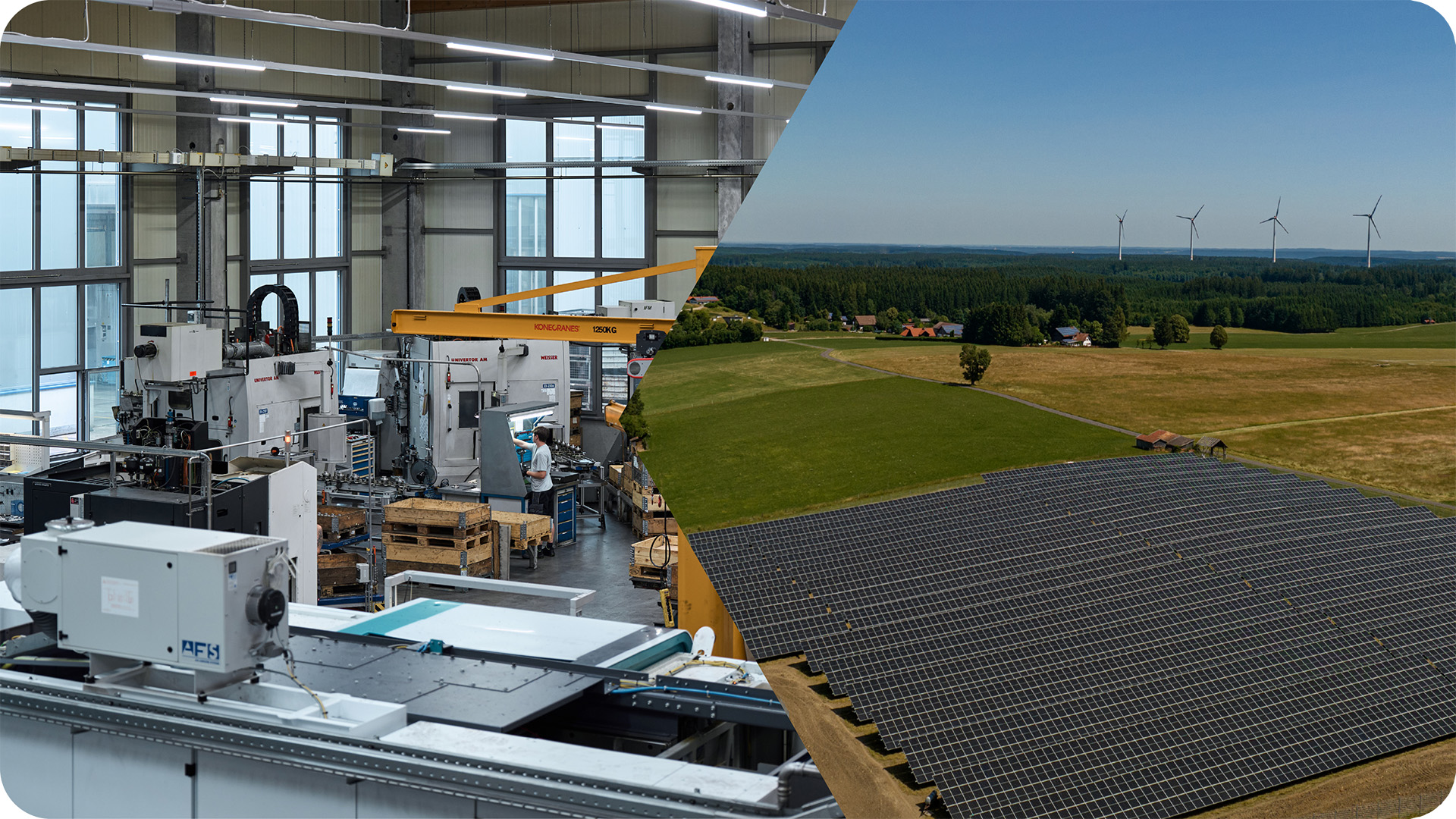
Many of the approaches mentioned in the Climate Path are already being implemented by us. These include the use of green electricity and our own photovoltaics, the use of CO₂-reduced material alternatives, the utilization of forging heat through controlled cooling, heat recovery, and the return of steel scrap to the material cycle. At the same time, we are continuously working to make our plants and production processes more energy and material efficient. Overall, we have been able to reduce our Scope 1 and Scope 2 emissions by more than 90 percent since 2018.
The Entire Value Chain is Required
The Climate Path shows that low-emission mass forging is technically possible – but not through a single measure. The industry needs sufficient renewable energy, efficient grids, and CO₂-reduced feedstocks at competitive prices. New materials and processes can also only be developed, tested, and transferred to series production in collaboration with customers, suppliers, and research partners.
“From steel manufacturers and energy suppliers to politicians, we must jointly find solutions and put them into industrial practice. We have already initiated many steps at NEUMAYER. We will consistently continue this path,” affirms Managing Director Dirk A. Neumayer, who is actively involved as a board member of the Industrial Association for Mass Forging.


