


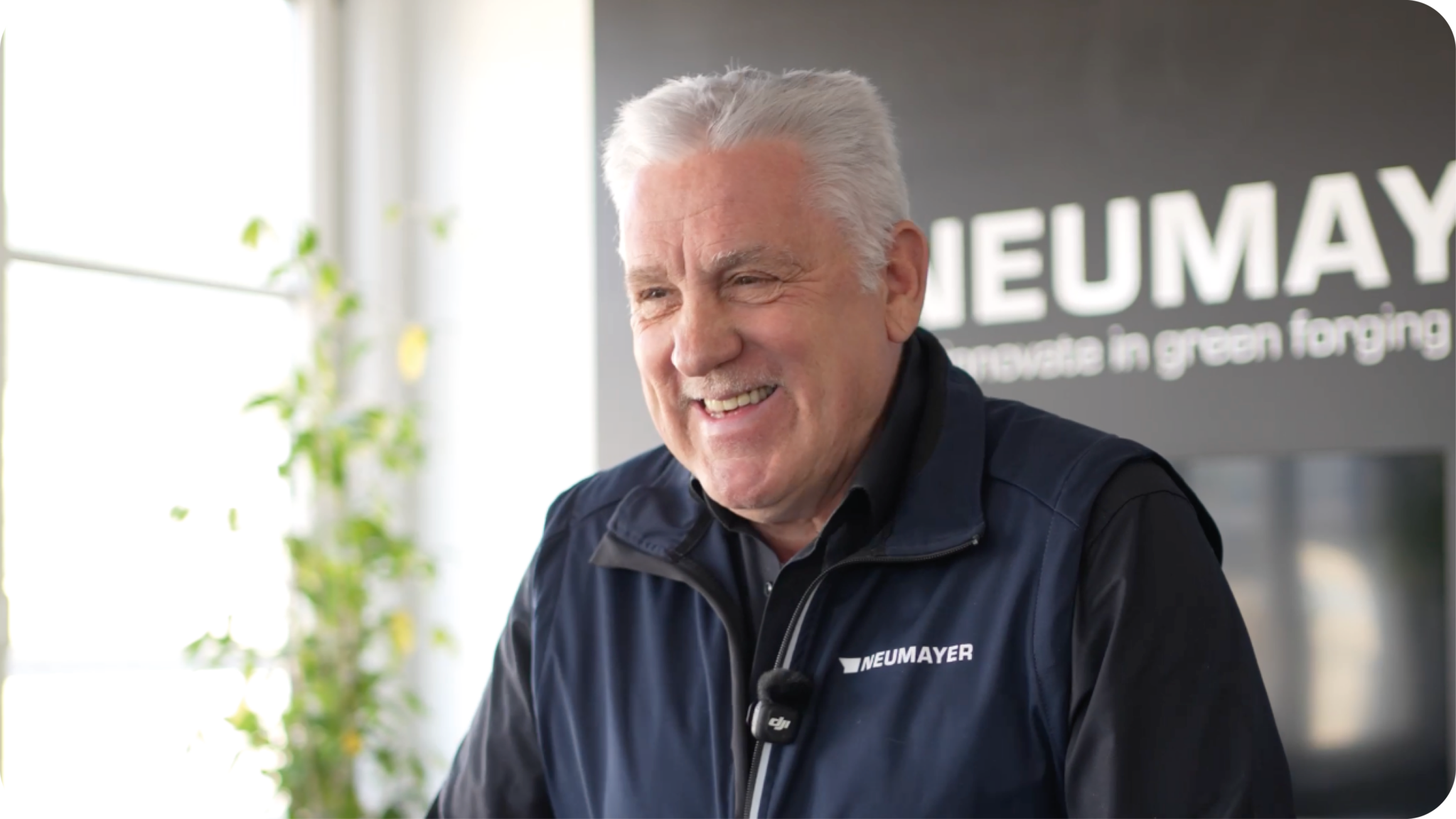
A Life in Forging: Thomas Olbertz Looks Back
When Thomas Olbertz talks about starting at NEUMAYER, his story begins with a situation that is hardly imaginable today. After military service and an apprenticeship at the Hausach-based company E. Hengstler (today Hengstler Zylinder GmbH), his employer was acquired by an American company. Therefore, Olbertz was quite open to new opportunities. Josef Keller, NEUMAYER’s HR manager, approached him and asked if he was interested in a change. And so, Thomas Olbertz introduced himself at NEUMAYER the next day. There was no lengthy process, no formal selection procedure. Instead, the decision was made immediately. “Josef Keller told me, ‘Thomas, just stay here.'” And Olbertz stayed for almost 43 years. He ended his first workday half an hour earlier than usual to resign from his previous employer. The next morning, his career at NEUMAYER began.
Initially, his path led him to the turning shop and assembly. But it soon became clear that this would not be the end of his journey. He moved to toolmaking and learned the craft from scratch – under conditions that differed significantly from today’s. Back then, tools were not developed based on a tool drawing; instead, the later component was the starting point. The tool had to be derived from its geometry. “You really had to rethink things,” he describes that time.
In the following years, the forge underwent a fundamental change. With the introduction of the first fully automatic presses in the 1990s, a new phase began. Olbertz was involved from the start in setting up the systems, designing the tools, and starting production. The work became more complex, and processes became more structured. Processes had to be coordinated, stage sequences defined, and tools continuously adapted. It was no longer just about individual work steps, but about the interplay of many factors.
At the same time, he continued his education. After work, he attended evening school, where he completed his master craftsman training. This was a time that demanded a lot from him but would pay off. One moment remains particularly vivid for Olbertz to this day. The then managing director, Albert Neumayer, asked him to send him the result of his oral master craftsman exam directly via SMS. “I passed,” was the good news. The next day, Olbertz was called to the managing director’s office. Shortly thereafter, he took on new tasks, first in an interdisciplinary team, later in a leadership position. His area of responsibility quickly grew to include forging, toolmaking, heat treatment, and cutting.
Concurrently, other major projects were underway. New presses were set up, systems expanded, and processes redefined. The setup and ramp-up of these systems are among the most formative experiences in Olbertz’ career. These were intensive phases: technically demanding, time-consuming, and associated with a lot of responsibility. “When everything worked out, you were very happy,” he says looking back.
Over time, his focus shifted. As production manager, his job was to maintain an overview. This included personnel scheduling, advance planning, documentation, and coordination. Which parts are running when? Are the tools prepared? Are the measuring instruments available? Are the teams correctly assigned? Many steps interlocked, and only when everything was prepared did production run reliably. “In the forge, you have to closely accompany the product,” he describes this responsibility. It became increasingly clear to him that a good forge does not rely solely on technology. The interaction of people is crucial: that teams function, that processes are coordinated, and that employees communicate with each other.
Looking back today, he says: “What makes me most proud is my career path. I started at the very bottom and worked my way up. I had many great experiences, visited customers, and even worked abroad.” His path was characterized by changes, new technologies, and ever-new tasks. Working in the forge is demanding and varied. It offers both professional and personal development opportunities. “It’s a great profession,” says Olbertz. After more than four decades, his conclusion is clear. There were many challenges, and doubts too. But he has never regretted his decision. “I wouldn’t do anything differently.”
With Thomas Olbertz’ departure, a long chapter at Neumayer comes to an end, marked by experience, commitment, and the willingness to take on responsibility. For almost 43 years, he accompanied the development of the forge, helped shape changes, and passed on his knowledge to many colleagues. We thank him for his dedication and his connection to the company. We wish him all the best for his new phase of life, good health, and time for the things that have been neglected until now.


