


From component idea to production-ready forged part
A new forged component comes into being long before production. Many critical questions must be asked much earlier: Is the idea technically feasible? Which material is suitable? Can the component be designed for manufacturing? Where are the optimization potentials in terms of weight, material usage, costs, or CO₂ footprint? And how can we ensure that an initial draft becomes a reliable series part? Even in this early phase, it’s worth looking at things from a manufacturing perspective. Those who understand the possibilities and limitations of bulk metal forming can design components from the outset so that function, economy, and manufacturability fit together optimally. The earlier technical requirements are clarified, the more precisely design and manufacturing can be aligned. This is particularly important for components that must withstand high loads, are integrated into complex assemblies, or need to be optimized from economic and sustainability perspectives.
Working together toward the right solution
In practice, a development project typically starts with a sketch, a drawing, CAD data, or a specific technical challenge. Together with the customer, we determine the component’s requirements, the loads it will encounter, the planned production volumes, and the objectives. Based on this, we assess technical feasibility, advise on material selection, simulate forming processes, and examine how the component can be optimized for manufacturing.
Bulk metal forming offers many possibilities, provided it’s incorporated into development early enough. This allows components to be designed so that material is used precisely where it’s needed for function and load-bearing capacity. At the same time, the fiber flow in the steel can contribute to achieving reliable component properties—provided material, geometry, forming process, and heat treatment are properly coordinated. This is particularly interesting when existing components need to be reevaluated. Cast, milled, or welded components can, under certain conditions, be replaced or further developed with forged, weight-optimized alternatives. This isn’t simply about switching processes, but about a comprehensive technical assessment: What function must the component fulfill? What loads occur during use? What geometry makes sense? Which material is appropriate? What machining steps are necessary? And how can the solution be manufactured economically and reliably in series production?
Prototypes, sample parts, test parts, and pre-series parts are an important building block in development projects. They provide confidence before major investments are made or series production decisions are taken. What matters is how closely these parts are produced under conditions similar to later manufacturing. We manufacture prototypes and small series under realistic conditions on series production equipment. This gives them high validity for tests, approvals, and the subsequent series launch. Our customers can test components, evaluate loads, and gain insights that are close to later industrial implementation. This reduces risks, as quality, process capability, and economy can be better assessed before series production starts. Development, prototype, and series production go hand in hand.
A practical example
A customer from the automotive sector approached NEUMAYER with a specific technical challenge. The existing component had previously been cast. The goal was to find a solution that would be more robust while meeting the requirements for function and installation situation.
Based on the existing drawings and CAD data, our specialist departments first examined technical feasibility. The focus was on component geometry, loads during later use, material selection, and the question of how the component could be designed for forging. The subsequent assessment showed that the component, when realized with an alternative material and as a forged part, could withstand higher loads in the installation situation.
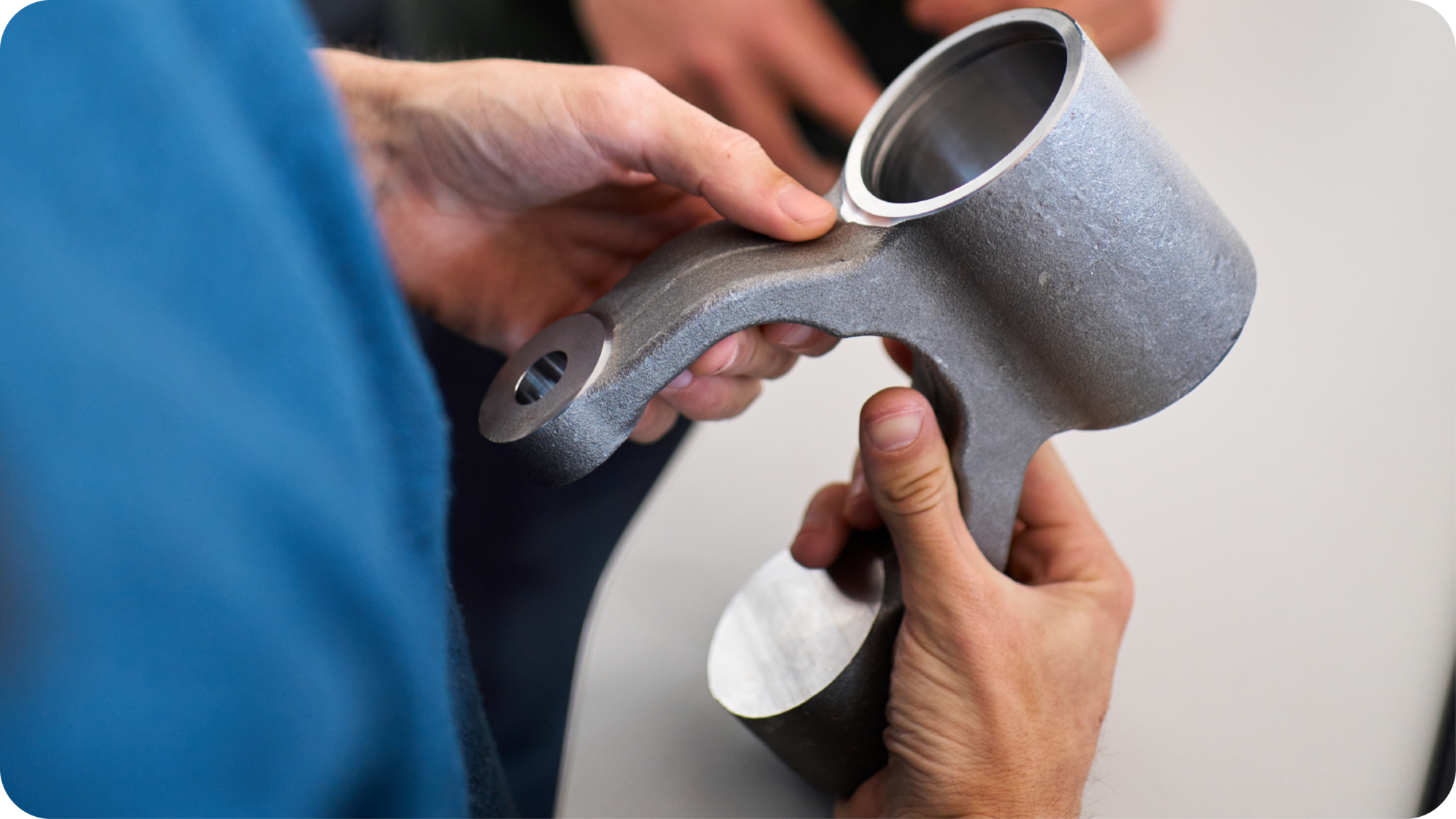
In collaboration with the customer, this resulted in an adapted component solution that was forged, machined, and assembled at NEUMAYER as a prototype under series production conditions. This provided the customer with reliable components for testing, approvals, and further industrialization.
This example illustrates how important early collaboration is. Many improvements don’t emerge from the finished product, but from joint technical development.
Innovation in the process
As an energy-intensive company, we know that technical developments today can no longer be viewed solely in terms of function and costs. Energy consumption, material efficiency, and CO₂ footprint also play an increasingly important role. That’s why sustainability is an integral part of technical solutions for us. One example is the development of a carbon-neutral drivetrain component on a balance-sheet basis. Across the entire process chain, we manufactured a forged component whose CO₂ footprint was significantly reduced through material selection, the use of green electricity, adapted process control, and other measures. The remaining CO₂ emissions were offset through high-quality certificates to achieve a net-zero CO₂ footprint for this component on a balance-sheet basis. Such projects demonstrate what’s possible when customers, development partners, and manufacturing work closely together.
Our advanced controlled-cooling process played an important role in this. During forging, the existing heat is deliberately reused instead of reheating the components in an energy-intensive manner after cooling. This allows the desired material properties to be achieved reliably while significantly reducing energy consumption and emissions.
We also support customers with our expertise in material selection. When technically feasible and economically sensible, CO₂-reduced steels or alternative materials can be used. Particularly in early development phases, the impact of such decisions on the final product can be evaluated especially well.
Development and innovation partnership
Development and innovation partnership doesn’t mean having a ready answer to every question. Rather, it means taking technical challenges seriously, thinking ahead early on, and developing viable solutions together.
Whether it’s a new component idea or optimization of an existing part: the earlier we’re involved, the better we can contribute our knowledge from bulk metal forming, materials engineering, process development, and series production. This creates components that are technically convincing, economically manufacturable, and suited to their specific application.


