


Quality Assurance in the Forge
Forged parts often perform safety-critical functions in machines, systems, and vehicles. They transmit forces, withstand high loads, and must function reliably for many years. Accordingly, the requirements for material, process control, and testing are extremely high.
At NEUMAYER, we don’t view quality as a final inspection step, but as a comprehensive system—from the raw material through the forging process to the ready-to-install assembly. Quality is not created at the end of production, but in every single process step.
The foundation of every forged part is the steel. Material certificates and specifications are verified, batches are clearly assigned, and processes are documented. Only when the material meets the defined requirements can a stable end product be created. Complete traceability forms the basis for reproducible quality and creates transparency throughout the entire value chain.
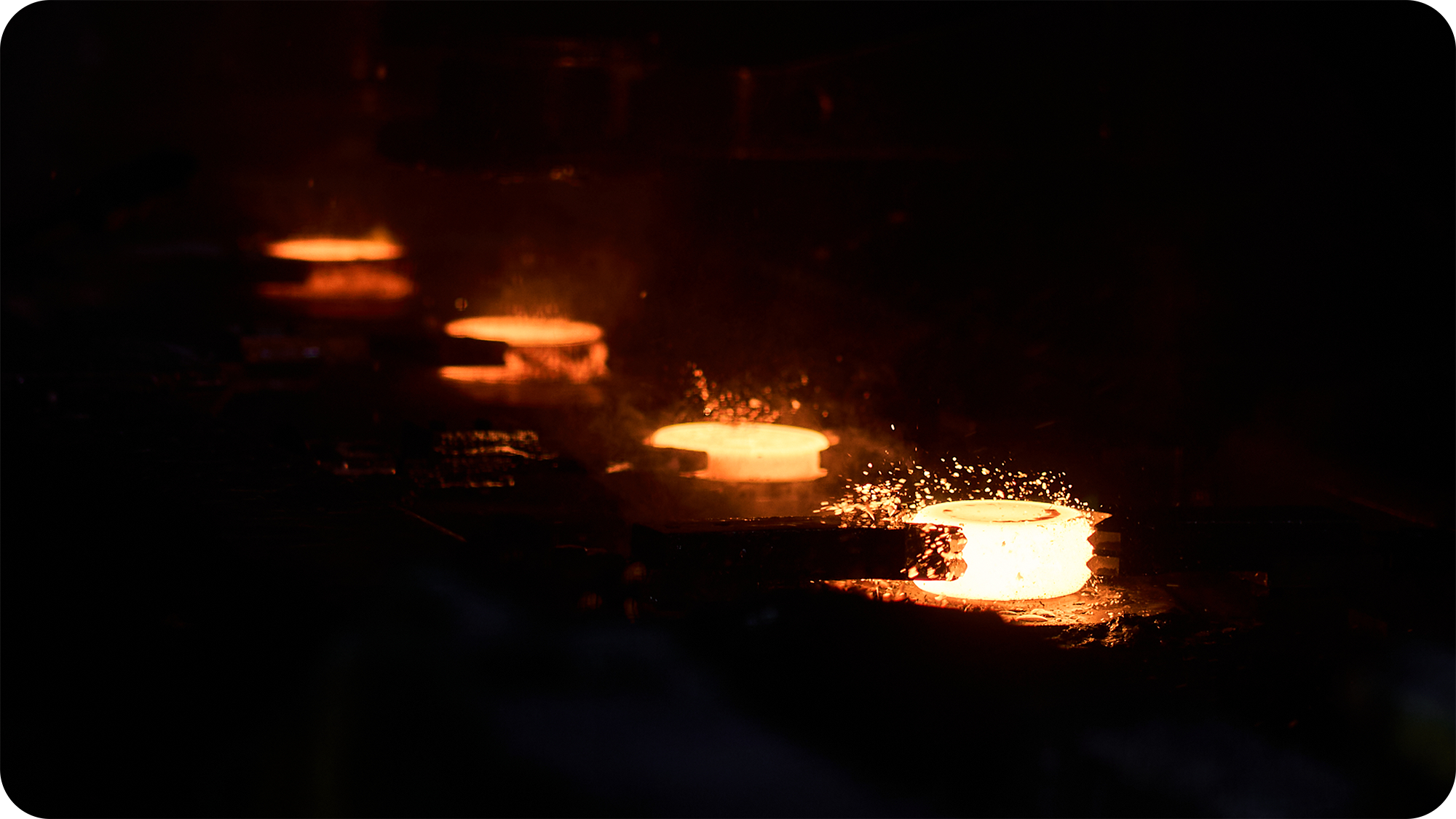
The relevant process parameters in the forging process are tailored to the component geometry, the material, and the subsequent stress. Temperature control and the degree of deformation are decisive for the microstructure and thus the mechanical properties of the component. We forge parts weighing from 0.5 to 20 kilograms with precision, near-net shape, and—where possible—flashless. This reduces scrap, minimizes material usage, and increases process stability.
An example of the connection between quality and energy efficiency is our controlled cooling process. We deliberately utilize the process heat generated during forging. Instead of allowing the components to cool completely and then reheating them energy-intensively for subsequent heat treatment, they remain in specially developed insulated containers. The existing residual heat is thus used in a controlled manner. This defined temperature profile supports the development of the desired material properties and contributes to consistently high component quality. At the same time, the process significantly reduces natural gas consumption and considerably lowers energy input compared to conventional heat treatments. Process reliability and resource efficiency are directly interlinked here.
In-House Tool and Special Machine Construction
A key component of our manufacturing depth is our in-house tool construction. The required forging tools are designed and manufactured within the company. The departments of development, tool construction, forge, mechanical processing, and assembly are closely integrated. Short distances enable rapid coordination and consistent process control. Adjustments can be implemented and validated promptly. This reduces interfaces and increases the stability of the entire production.
Our special machine construction department complements this structure as an internal center for customized solutions. When no suitable system exists for a specific task, we develop it ourselves. This creates tailor-made machines and testing fixtures that are precisely matched to our products, processes, and quality requirements. This requires experience, technical understanding, and pragmatic approaches. This combination of engineering expertise and practical implementation sustainably strengthens our process reliability.
More than half of our blanks are mechanically processed in-house. Turning, milling, drilling, and deburring are performed on a modern machine park. Dimensional accuracy, surface quality, and functional requirements are monitored throughout the entire manufacturing process.
Material Testing and Final Inspection in Our Own Laboratory
In final production, we test all products according to customer specifications as well as internal quality criteria in our own materials laboratory and measuring room. Our materials testers perform non-destructive as well as mechanical and metallurgical examinations.
Non-destructive testing methods include visual, crack, and eddy current testing, among others. They enable early detection of surface and edge defects without damaging the component.
In addition, mechanical tests such as tensile tests, notched bar impact tests, and hardness tests are performed. Metallurgical examinations, including microstructure analyses, provide information about the internal structure of the material and enable evaluation of the forming and heat treatment processes. We combine modern testing methods with qualified expertise. Only the interplay of technology, experience, and clearly defined testing criteria ensures reliable results.
Quality, Efficiency, and Sustainability Belong Together
Stable processes reduce scrap and rework. Near-net-shape forming minimizes material usage. Energy-efficient processes reduce resource consumption. Every avoided rework means less energy input and lower emissions. Technical precision is therefore always a contribution to responsible resource management.
As a system partner, we support our customers from development through production to assembly. The foundation for reliable collaboration is our technical expertise, our high manufacturing depth, and our comprehensive testing capabilities at our Hausach location.


